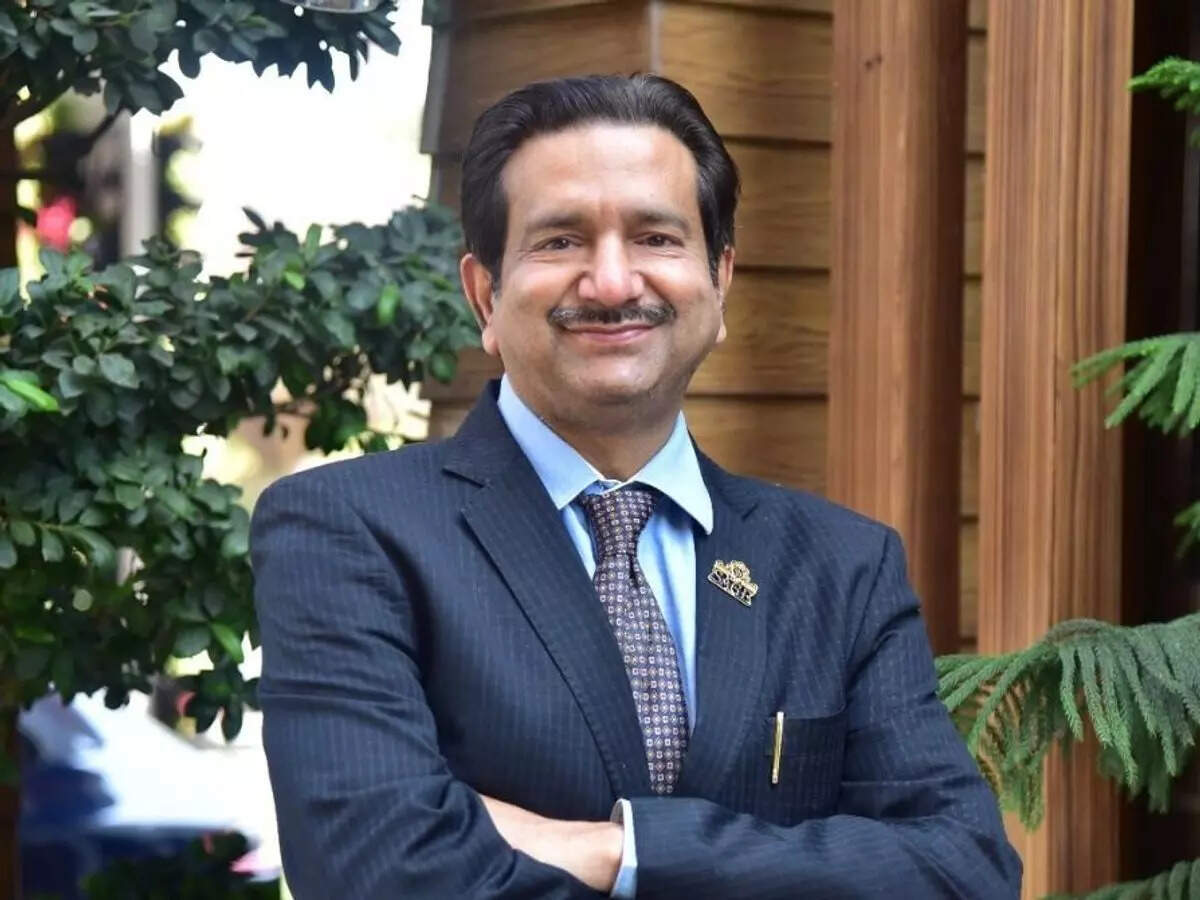
Er. Sanjeev Agrawal, Chairman and Managing Director of SAGE Group and Chancellor of SAGE University, stands at the centre of one of Madhya Pradesh’s most dynamic growth narratives. Over the past two decades, he has built a diversified enterprise spanning education, real estate, renewable energy, and hospitality—sectors that now anchor the state’s development agenda.
In this conversation with ETGovernment’s Sudhanshu Mishra, he reflects on the emerging opportunities in Madhya Pradesh’s business ecosystem, the evolving contours of public–private partnerships, the state’s infrastructure priorities, and the transformative impact of NEP 2020. He discusses his investments in clean energy and hospitality, the integration of emerging technologies across institutions, and his \ vision for skilling, innovation and inclusive growth.
Edited excerpts:
How would you assess the current business environment in Madhya Pradesh, especially in terms of ease of doing business? Which government measures have helped SAGE Group the most?
Madhya Pradesh today offers a significantly enhanced business ecosystem marked by clarity, speed, and predictability. The state’s single-window clearance mechanism has become far more efficient, helping reduce regulatory friction. Moreover, policy clarity across high-growth sectors—education, real estate, energy, and hospitality—has made it strategically viable for us to plan large-scale and long-term investments. These reforms, combined with a proactive administrative framework, give us the confidence to move forward with ambitious projects such as Hilton Hospitality, SAGE Medical College, and Sage Tower Realty. The government’s willingness to engage with private enterprise and co-create solutions has been instrumental in shaping our growth roadmap.
In your view, what are the most critical infrastructure gaps in Madhya Pradesh — physical and digital — and how are SAGE Group entities like Agrawal Power and Sage Realty contributing to fill them?
As the next wave of economic development unfolds, Madhya Pradesh needs to prioritize two core fronts: modern connectivity and sustainable urban infrastructure. On the physical side, better transport networks, integrated urban planning, and smart commercial spaces will be critical. Digitally, the state needs to deepen broadband penetration and build future-forward campuses.
Agrawal Power is contributing to this vision by scaling clean energy capacity. By investing in renewable energy, we aim to support both the state’s industrial growth and its commitment to sustainability. On the real estate front, Sage Realty is creating landmark business infrastructure — such as our Sage Tower Realty project — that is technologically enabled, environmentally conscious, and designed to host future-ready enterprises. Our engagement with the government also goes beyond construction: we actively participate in investor forums, skilling partnerships, and public-private development dialogues.
Given the growing role of public–private partnerships (PPP), how do you see PPP models evolving in sectors like education and healthcare in Madhya Pradesh? What are key enablers?
There is a compelling case for PPPs in both education and healthcare. These sectors inherently demand scale, innovation, and capital — and when aligned with the right private partner, they can deliver impact at speed. From our perspective, successful PPP execution in these sectors requires: a stable and transparent policy framework, clear performance metrics, robust governance, and long-term commitment from both public and private sides.
For example, our planned SAGE Medical College could be structured on a PPP basis, combining public infrastructure with private operational strength. We are also collaborating on government-organised awareness campaigns and capacity-building initiatives, which reinforce trust and shared purpose. The goal is not merely expansion, but delivering quality outcomes and affordable access.
What role is SAGE Group playing in talent development and job creation in Madhya Pradesh, particularly for youth?
At SAGE, we believe education and employment go hand in hand. Through SAGE University, we design academic programmes that are closely tied to industry needs — thereby ensuring that students graduate with not just degrees but relevant, employable skills. Every year, we train thousands of students in fields ranging from management and technology to healthcare and hospitality.
With our upcoming projects — notably the Hilton Hospitality venture and SAGE Medical College — we are set to generate a new wave of employment opportunities across multiple skill levels: from entry-level roles to specialized professionals. We also partner with government skill missions, participate in job fairs, and support state-led youth empowerment programs to ensure that Madhya Pradesh’s young talent is ready for tomorrow’s economy.
NEP 2020 is reshaping higher education in India. What challenges has SAGE University faced in implementing NEP 2020, and what opportunities has the policy opened up?
Implementing NEP 2020 is a transformative process, not just incremental change. On the challenge front, we need to redesign curricula to be flexible and multidisciplinary, retrain faculty to adopt new pedagogical models, and integrate experiential learning systems at a large scale. These are significant undertakings, but they are also strategic investments in future-ready education.
At the same time, NEP 2020 unlocks tremendous opportunity: it enables us to offer skills-based and outcome-focused education, deepen industry–academia collaboration, nurture innovation through incubation centres, and offer students interdisciplinary flexibility. For SAGE University, this means offering courses that are more aligned with real-world demands, facilitating cross-domain mobility for students, and fostering a research-driven, entrepreneurial mindset. Ultimately, NEP 2020 is not just a policy for reform — it is a framework for building a new generation of leaders, innovators, and thinkers.
How is SAGE Group integrating emerging technologies such as AI and Machine Learning into its education and operational models?
Our strategy is twofold: embed technology into the academic DNA, and deploy it in our operational ecosystem. Academically, we have established AI and ML laboratories, introduced Industry 4.0-aligned curricula, and built a fully digitised campus infrastructure. These measures ensure students gain exposure to cutting-edge tools, platforms, and problem-solving frameworks.
Operationally, we plan to leverage AI-driven analytics, intelligent systems, and automation in our hospitality and healthcare projects. For example, predictive maintenance, energy optimisation, and smart facilities management can all benefit from data-driven decision-making. We also engage regularly in technology summits, hackathons, and policy forums — both to stay ahead of shifts in technological adoption and to influence the broader dialogue on how emerging tech can be responsibly integrated into education and infrastructure.
You have made significant investments in renewable energy and hospitality. What is the long-term vision behind these investments, and how will they impact Madhya Pradesh’s economy?
Our long-term vision is rooted in sustainable, inclusive, and scalable growth. On the energy front, we are committed to scaling clean, reliable power solutions. By investing in renewables, we want to support Madhya Pradesh’s industrial growth while also contributing to its environmental sustainability goals.
In hospitality, the Hilton Hospitality project is central to our strategy. We aim to build a world-class hospitality ecosystem that not only serves business travellers and tourists but also catalyses regional investment, conferences, and high-value commerce. This will help transform key cities into global and national hubs of business and tourism.
Economically, both sectors drive high multiplier effects: they create direct employment, stimulate local supply chains, and attract capital. In the long run, our investments will contribute meaningfully to job creation, urban development, and the diversification of the state economy.
Which SAGE Group projects are you most bullish about, and how do they align with Madhya Pradesh’s growth priorities?
Three projects stand out in terms of their scale, impact, and alignment with state-level priorities:
Hilton Hospitality — This will significantly strengthen the state’s hospitality infrastructure and help position Madhya Pradesh on the national and global tourism map.
SAGE Medical College — A key investment in health infrastructure and professional education. It will expand access to quality medical education within the state and reinforce its healthcare capacity.
Sage Tower Realty — A modern commercial infrastructure initiative that will support new enterprises, startups, and knowledge-driven businesses.
These projects are not just business ventures; they are long-term commitments to the state’s socio-economic development. They align with Madhya Pradesh’s vision of inclusive growth, skill development, sustainable infrastructure, and entrepreneurship.
As a leader, what guiding philosophy shapes your decisions, and what advice would you give to young entrepreneurs in Madhya Pradesh?
My leadership philosophy rests on three pillars: dedication, transparency, and community-centric development. Every initiative we undertake is measured not purely in business outcomes, but also in public value. We work not just to scale, but to meaningfully contribute to society — in education, energy, wellness, and infrastructure.
To young entrepreneurs in Madhya Pradesh, I would say: “Aspire with purpose, learn relentlessly, and remain flexible in your journey.” The state is entering a phase of tremendous opportunity — driven by policy reforms, infrastructure investment, and demographic advantage. If you combine innovation, perseverance, and a service mindset, you can play a defining role in shaping Madhya Pradesh’s next chapter.